About Us

As a collector of 3rd Reich militaria for over 30 years the dream of putting together a web site dedicated to collectors that share my same passion, came true in December of 2012. With the encouragement of family, friends, fellow collectors and most importantly my son Kristofer, Meda Militaria finally became a reality that was long over due.

Whether you are someone that is just starting out in the hobby or a seasoned der alter Hase, Meda Militaria has something for every level of collector. We strive to do our best at describing every item that we offer, and to insure the originality of everything that we sell.

“Guaranteed to your complete satisfaction” is a statement that I’ve used for years in this hobby. We’ll always standby those words because, the only time that we’re happy……..is when you’re happy.

We are always interested in purchasing anything from a single item up to collection, so please use the contact information if you have something to sell.

With that short introduction we would like to welcome you to Meda Militaria.

– JR-
Hello and welcome to Meda Militaria. I was born and raised in Fort Collins. I have been married now for two years to my lovely wifey for lifey Katie, pictured below as we visited Normandy Beach. I have always been an entrepreneur and have been raised with a great set of values and beliefs by my parents.

Ever since I can remember, I have watched my dad buying, selling and collecting 3rd Reich edged weapons. When I was younger, the various daggers and swords in his collection just looked like a bunch of cool toys. It was only after he found me digging in the sand box with one of his K98 bayonets, I found that these weren’t toys, and especially not for kids.  I remember him showing me the latest catalogs from Manions Auction House, Der Gauleiter & The Wittmann Offering, and watching him drooling over the plethora of items being offered for sale. When he did come home with a new dagger or sword, he wouldn’t set it aside for a single moment, even when told it was time for dinner. Like a kid on Christmas day, he just studied his new found treasure for hours on end, and day after day.

With the coming of the Internet and the computer age, it was only a matter of time before he would take the jump in to the new discussion forums popping up on 3rd Reich militaria. Finally, being able to share his collection of 3rd Reich edged weapons with other collectors became a reality. As being one of the first members to join the German Daggers forum website in the year 2000, he soon formed bonds of friendship with collectors around the world, that shared the same collecting interests. I find myself with that same passion and excitement for 3rd Reich militaria as I saw in my dad as we now embark on a new adventure while launching our new website together and building my own collection.  Welcome to Meda Militaria

-Kris-

Type C Chain

Type C Chain – Blog Post

No Slide Found In Slider.

Type C Chain

Now that we covered the Type A, B1, and B2’s, the last chain variation that I want to touch on is the Type C’s. This SS M36 chain configuration deviates from all of the other varieties, in many ways. We don’t see these Type C’s all that often, and it’s tough to get a decent example to use as a comparison to show the differences. But this one will have to do.

1. The skull and runic links on a Type C will be plated steel. During the early production period the plating held up quite nicely. But later in the production era, this finish was much thinner, and prone to oxidation and loss of material.

2. If you look at the skull and runic links of a Type C chain, they are completely different in characteristics and appearance, from the other chain varieties. The skull & runes have a unique shape, the connectors are heavy and round, and almost every feature completely differs from the other 3 chains discussed.

3. It is a rare exception that you will encounter a Type C chain, in which the links have will have burnished backgrounds. Generally speaking, they will be entirely plated.

4. The connectors to the Wotan’s knot are in a straight cut, instead of being beveled. And the actual Wotan’s knot is separate piece which is wielded to the clip. With the other 3 chain variations, the clip and cloverleaf are together as one unit.

5.  And lastly, the center band on the scabbard of a Type C chain, has it’s own characteristics which vary from the other 3 examples shown previously. The 6 meandering swastikas have a rounded appearance, as opposed to being flat.

There you have it. Hopefully this clears up some questions that you might have on different chain variations, associated with the M36 SS daggers.

Type B2 Chain

Type B2 Chain – Blog Post

No Slide Found In Slider.

Type B2 Chain

Now the Type B2 SS chains, follow pretty much the same characteristics as we see with the B1’s, but with one major difference. The links are now being struck from a ferrous material, and are magnetic STEEL, instead of nickel. Here are some of the other traits that can be seen with the B2 chain configurations:

1. All the links, connectors, Wotan’s knot and center band, are now made of steel construction. For the most part, they will be matched to an anodized scabbard, instead of a painted shell.

2. Where we saw burnished backgrounds in the components of the 2 previous discussed chain variations, the B2’s can have blacken links at times, and other occasions void of this extra manufacturing step.

3. While the connectors to the Wotan’s knot remain consistent and nearly the same as the B1’s, the Kulturzeichen is now changed. It has a squared off look to it, with the runes spread out more laterally.

4. The center band too, is now more flared with a rolled edge, on the B2 chains.

Type B1 Chain

Type B1 Chain – Blog Post

No Slide Found In Slider.

Type B1 Chain

The Type B1 chain configurations are very close in terms of construction, and most likely the reason that collectors for years, never saw any difference apart from the Type A’s. Like the Type A’s, this chain assembly on the Type B1’s is usually matched to a scabbard which is painted with black enamel. Here are some other characteristics:

1. The links are heavy nickel silver and have close to the same feature characteristics as the Type A’s. But now on the Type B1’s, the skull is void of the septum in the nose. In regards to the runes link, the SS lighting bolts have a little more spacing between them, that what is seen with the Type A’s.

 2. Many Type B1 chains have retained a nice black background, unless they have been extensively cleaned. The reason for this, is that the pebbling within these links, was more pronounced and raised. Being such, it held the burnishing better than the Type A’s, which had a smoother finish.

 3. The Wotan’s knot and Kulturzeichen on the Type B1 chains is identical to what you will see with the Type A’s, as there doesn’t appear to be any differences. But the connectors to the cloverleaf, are now seen with a bevel and more narrower look to them.

 4. And lastly, the center band on the Type B’s is just a little wider than what we see on the Type A’s. As the top flares out just a little bit, instead of being cut straight.

Type A Chain

Type A Chain – Blog Post

No Slide Found In Slider.

Type A Chain

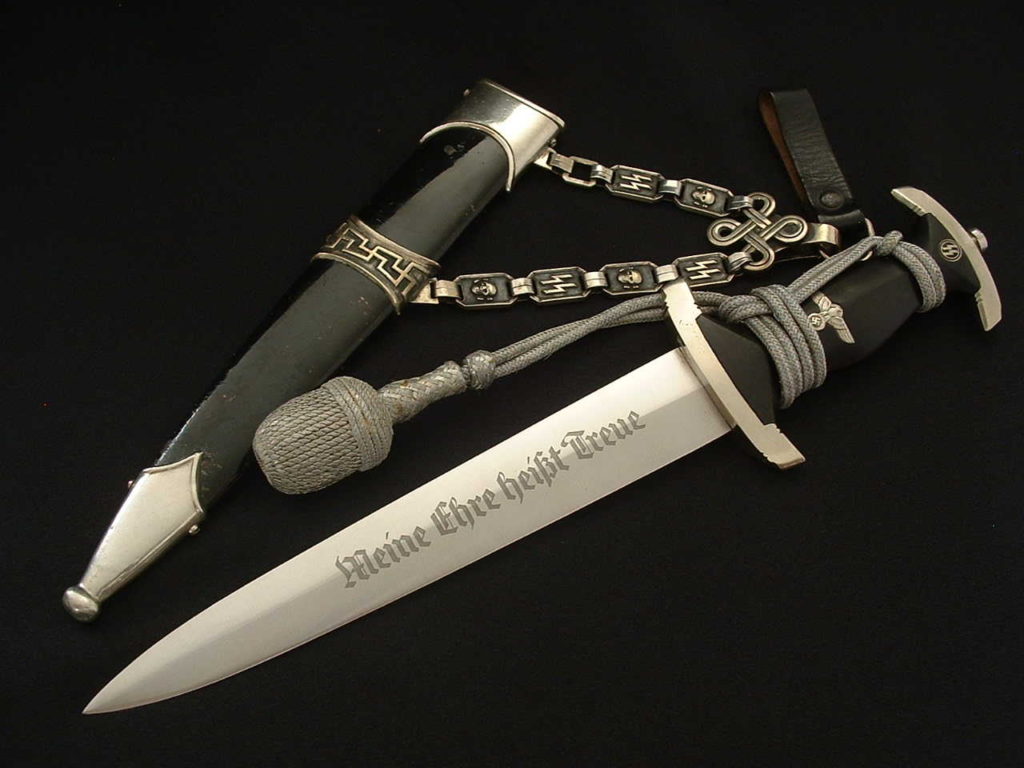
Himmler approved of a new type of scabbard hanger for the SS dagger, on Aug 25th, 1936. This became known as the M36 Chain Dagger. These new SS daggers with a chain suspension scabbard, have absolutely fascinated collectors of 3rd Reich edged weapons. Up until a few years ago, the terminology for the different chain configurations was quite confusing, to say the least. And even today, many enthusiasts as well as dealers, sometimes error in the actual type of chain dagger that they are discussing. Collectors previously used the terms Type I and Type II, as a matter of distinguishing what was thought to be the only 2 variety of chains. Then a new chain configuration was noticed about a dozen years ago, and it was termed Type III. That really threw a wrench into the mix, and made matters worse. The different names associated with theses chain varieties, was now totally cobbled. That’s because there was no correlation with any specific type of chain, and  the time period that it was produced.

With the publishing of Ralf Siegert’s reference on SS edged weapons, he for the first time, laid out a chronological manufacturing time line. He also drew as distinction and categorized 4 different chain varieties. In doing so, he showed what was produced first, second, and so on. Ralf also renamed the chain configurations, to help collectors see the differences and separate the characteristics identifying each variety. In this 4 part article, I’ll take it a step further in attempt to help collectors understand the differences between the 4 SS chain varieties, and how to identify them. In doing so, I will use the terms that Ralf came up with in his reference. Referring to the 4 chain varieties as the following: Type A, Type B1, Type B2, & Type C.

The Type A SS chain configuration was misidentified for many years. I recognized this anomaly about 12 years ago, when I purchased an SS Chain dagger from a gun dealer, at the Show of Shows in Louieville Kentucky. When looking closely at the chain suspension, I noticed that the skull links had a septum in the nose of the skeleton head. I compared this characteristic to another early M36 chain that I owned, but it didn’t have this feature. Ha, now there was a new type of chain, that wasn’t identified in any previous 3rd Reich edged reference, or even known of by the collecting community! So that is the first difference that collectors need to be aware of, when identifying the earliest Type A chain daggers.

These Type A’s without a doubt, are the initial production variety seen associated with the SS chain dagger. Along with the septum in the nose of the skull link, there are a couple other minor differences with this introductory model chain assembly. But they as not all that noticeable nor distinct, and may be difficult to discern at first. These are the other characteristics of the Type A chains:

 1. All are manufactured of nickel silver, with the links struck quite thick. They will be matched to a black painted scabbard.

 2. The background pebbling in the links is not all that profound or raised. And as a result, many of these early chains did not retain the black burnishing designed to bring out the features of the skull & SS rune links. The sigrunes in the runic link, have a thick profile and nearly touch each other.

 3. The connectors which fasten to the Wotan’s knot, most of the time have a broad flared wide look, as opposed to a narrow taper.


 4. The Kulturzeichen culture proof mark is lightly hand stamped, and has a unique look. The appearance is elongated, with a spiral twist.

 5. Finally, the center band to these Type A’s, is actually slightly thinner than what you will encounter on the other 3 chain configurations.

The Type A chain was not in production very long. The most obvious reason, was the lack of quality nickel in which to manufacture them with. As Germany geared up for war, nickel disappeared as a metal used in the production of 3rd Reich edged weapons. These Type A chains found with the septum in the nose of the skull links, are extremely desirable, and highly sought after by 3rd Reich Edged weapon collectors.

The SS Chain Dagger

The SS Chain Dagger – Blog Post

No Slide Found In Slider.

The SS Chain Dagger

In terms of components used within the production time frame, there was never a more complex edged weapon produced during the 3rd Reich, than the Model 1936 SS Chain Dagger. This edged weapon ran the entire gamut and then some, in regards to how it was manufactured. Just look at the variables that can come into play, when considering one of these daggers. It’s no wonder that collectors at times can be confused, in trying to determine the authenticity of these M36’s. Here is what they are faced with, in analyzing these complex, and fascinating daggers. First off, they were carried by mostly officers, but NCO’s, and even enlisted men could wear them if certain membership requirements were met. But here is where the fun begins, with the vast array of combinations in which we see these daggers found. We have the following:

Early Period
Mid Period
Late Period
Type I
Type II
Type III
Type A
Type B1
Type B2
Type C
burnished chains
non-burnished chains
plated chains
nickel fitting
plated fittings
steel fittings
zinc fittings
mid period with both plated and nickel components
no maker blades
maker marked blades
RZM marked blades
Rohm blades
Himmler blades
nickel crossguards
Gruppe marked crossguards
plated crossguards
anodized (blued) scabbards
painted scabbards
with portapees
without portapees
nickel emblems
plated emblems
aluminum emblems
copper emblems

Can it get any more complected than that? And I’m sure that there are some additional variables that could be added to the list. Anyway, that’s what makes the hobby fun. Analyzing the production time frame in which these daggers were manufactured, and how the components changed over the years. And certainly also, some of the combinations that the M36 may encompass, and are found. They were highly revered edged weapon worn by their owners back in the day. And certainly one of the most sought after 3rd Reich edged weapon by collectors today.

GPB

GPB Blog Post 1

No Slide Found In Slider.

GPB

Stalag Luft III was a POW camp set up by the Nazis during WWII that primarily housed captured air force personal that had been shot down. The camp was located in the providence Lower Silesia near the town of Sagan 100 miles south east of Berlin.

During the spring of 1943, a planned escape was devised in which the interned POW’s were to tunneling beneath the camp in an attempt to gain their freedom. The complexity of the scheme and in addition to the slow and laborious digging of the escape route, took an entire year to complete. Finally in March of 1944 it was completed and ready.

Initially, the operation called for 200 of the of the POW’s to make their way to freedom on the night of March 24th.  The unexpected difficulty of maneuvering such a large number airmen inside of the narrow and dark tunnel fell short, and only 76 actually made it out of the facility. Of the 76 escapees, only 3 eventually made it to freedom. The other 73 men were hunted down and recaptured.

Upon hearing of the escape Hitler was furious. As a display of his anger and to set an example to all of the POW’s interned in Stalag Luft III, he initially called for the execution of 200 of the interned airmen from the camp. In the end, 50 of the recaptured POW’s were to be summarily murdered. The Gestapo was assigned to carry out the investigation of the escape, and the execution of the 50 POW’s in reprisal for it.

The Gestapo regional headquarters in Berlin was commanded by Oswald Schafer. Upon receiving the telegraph with Hitler’s orders regarding the execution of the recaptured POW’s, Schafer sent his  driver to gather his second in command Martin Schermer, and 2 other agents, Edward Geith &  Johann Schneider. After a conference with Schafer who explained the execution orders from RSHA to the other 3 agents,  they all proceeded to KRIPO headquarters to retrieve 2 of the held escapees, that had been recaptured. Downed airmen Rupert J. Stevens and Johannes S. Gouws both from the SAAF, were hustled into the waiting vehicle and were driven to the German countryside during the dark of the night. The Hitler execution order for the murdering of the 50 condemned POW’s was explicit. All were to be shot in the back at close range, using a fully automatic weapon or a machine gun. Since Gestapo agent Johann Schneider was carrying such a weapon, it was decided that he would be the executioner. With the vehicle pulled over to the side of the Autobahn, POW’s Stevens and Gouws were pulled from it, and led a short distance off of the road. On Schermer order, Schneider murdered both of the airmen in cold blood.

During the subsequent trial which culminated on Sept. 3, 1947, the 17 Nazi war criminals who were responsible for the murders of the 50 POW’s from Stalag Luft III, received the death penalty. This included Berlin field Gestapo agent, Johann Schneider. In Hameln Germany on Feb. 27, 1948, Schneider as well as the others received their just reward at the hands of British executioner and hangman, Albert Pierrepoint.

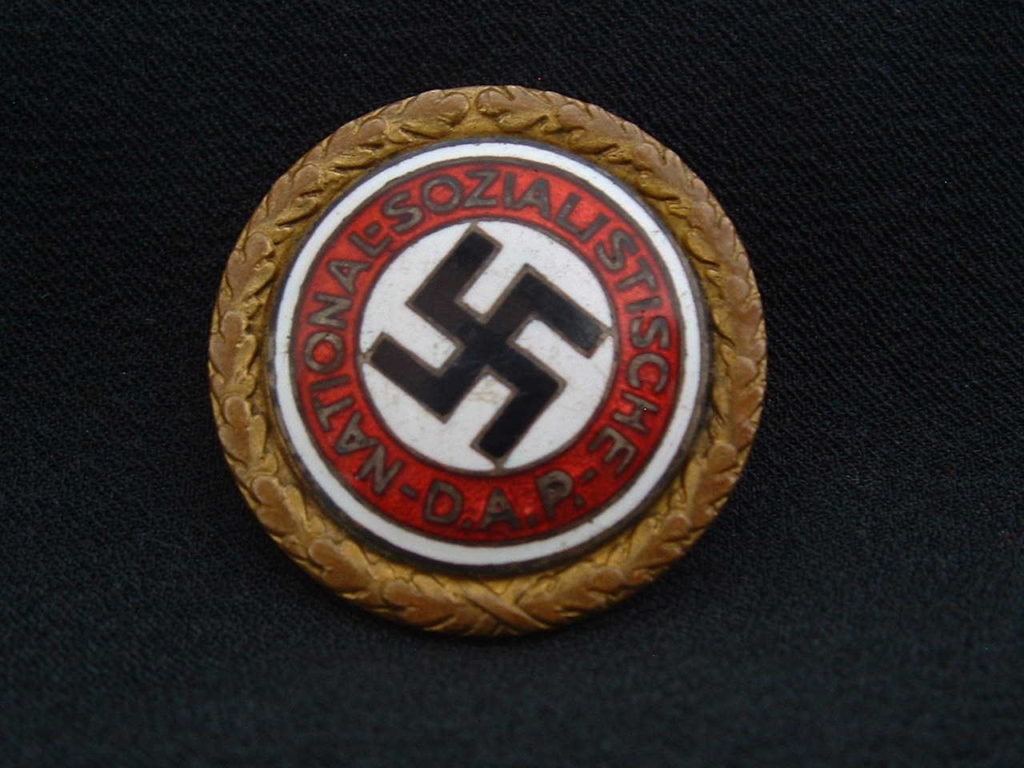
Approximately 1972, well known 3rd Reich historian and antique collector Gailen David, purchase a 30 mm Gold Party Badge from a US service veteran living in Maryland. The badge was in decent condition except for the fact that half of the pin was missing (a common occurrence), and also that an attempt to deface the owner’s NSDAP number was evident. Gailen tossed the GPB in a box where it remained for over 20 years.

In 2010, Kris Meda, a new collector in 3rd Reich antiques, purchased this Gold Party Badge from Gailen. By using a pencil and paper, Kris sketched and traced over the partially effaced number on the reverse of the badge, and was able to extract and bring out the digits of the scratched NSDAP #. That simple investigating process revealed that the badge had initially been stamped with the 4 digit number, 8435. Using this information, Kris ran a check of known NSDAP party numbers on file. It revealed that GPB number 8435 belonged to none other than, Gestapo agent Johann Schneider.

That explains why there had been a half hearted attempt to scratch out and erase the identifying number on the reverse of this badge. It was clearly an attempt to hide it’s owners sinister identity, as well as his torture and murderous past. In the end, no doubt Nazi War Criminal Johann Schneider tried to slip into obscurity during the collapse of Nazi Germany. Try as he may have, he couldn’t escape the rope that was to be placed around his neck at the hangman’s gallows, in Hameln Germany.

Portapees and Knots

Portapees and Knots – Blog Post 2

No Slide Found In Slider.

Portapees and Knots

3rd Reich Edged Weapon portapees and knots are a neat study by themselves. Many collectors have never stopped to think, ‘what the heck are those strange dingle ball items that hang off the grip assemblies that we see on several 3rd Reich daggers, and what were they for?” Well to answer the second part of the question, portappees first made their appearance during early European times, when wars were fought by armies of soldier vs soldier in a non-mechanized combat era. An important segment of any of these armies was their cavalry units, and this is where the portapee came to be very important to mounted on horseback. The portapee or sword knot was wrapped around the hilt of a sword with the strap and knot portion wrapped around the wrist of warrior’s fighting hand. If during the course of battle, a sword were to be knocked from the hand of a cavalry soldier fighting from the saddle , the portapee wrapped around the hilt of his weapon and his wrist allowed him to retain possession of it and all was not lost.

Now move ahead to the 3rd Reich Era. The portapees found on the daggers and swords of Hitlers Germany, were for the most part decorative accouterments. But we do find in some instances that they did signify something other than a decoration dangling from the hilt of a sword or dagger. Tommy Johnson in his 3rd Reich Edged Weapons reference series, shows the proper described the way that many common portapees were to be tied, but we also know from period photos and veteran purchased un-touched pieces, this practice was not always adhered to and followed. To me there is just something amiss when I see an Army, Navy or 2nd Model Luft dagger that doesn’t sport a portapee around it’s hilt assembly. It makes the dagger look naked to me, and therefore everyone on my own personal collection of Military Daggers, has some type of portappee tied around the grip. Lets touch on the basic ones, and then look at a few others that we see less often.

The Army Dagger. Whether you’ve been a collector for 20 years or just started last month, this is the 1st dagger that we usually encounter with a portappee tied on it. The Army Dagger Portapee tie is pretty straight forward and with few slight variations, is usually tied in the fashion that you see in these photos. The Army Portapee is usually 43 cm length, that can be found slightly shorter or longer and with varying thickness of the cord itself. As with the cord, the knot too can vary in length and diameter. When you tie these darn things, tie the top first, but then slide it to a position in the middle of the grip to give you the slack to complete the remainder of the wrap. Then slide that first section of the cord up to the pommel area of the dagger where it belongs. If you don’t do this, you find yourself trying to stretch and lace the larger knot portion through small openings of the cord. From what I understand, all Army Officer 3rd Reich Daggers were issued with a portapee to be worn with the dagger.

The Luftwaffe Daggers were worn with a portapee when the officer was attached to a “Flying Corp”. In other words, I take this to mean a Luftwaffe Pilot, Observer, Gunner or any other personal that was directly or indirectly attached to a flying group. The official Luftwaffe Dagger Portapee is described as being 23 cm and Tommy Johnson shows the proper wrap being tied in a crossing pattern over the hilt of the 1st model Luft daggers. If you have ever tried to wrap a portapee on a 1st model, you’ll notice that most of the time it will interfere with the dagger being properly set in the scabbard. (We see this same challenge later on with the SS M36 Dagger when the Waffen Officers were allowed to wear the Chained SS with a portappee. ) So at times we’ll see the shorter 23 cm Luft portapee wrapped in various ties when associated with the 1st model pattern daggers. Most of the time we don’t even see a portapee on these 1st models.

The 2nd Model Luft Dagger. As with the Army Officer’s dagger, the tie of a portapee around the hilt assembly of a 2nd model Luft, was spelled out in period literature found in Solingen after the war. The dagger hilt is wrapped in a simple crossing pattern that is just tied around the grip itself,and not like the Army Dagger that encompasses both grip and crossguard. When you tie a portapee on your 2nd model Luft, at times it’s easier to form the knot in your hand first and then slide it down over the grip. Because of the length of the cord being approximately 23 cm, it doesn’t afford a lot of slack to work with when trying to complete this tie.

The Navy Officers Dagger. Warning, if you decide to tie this knot, make sure that none of your family members, your dog, nor any of your friends are in the immediate vicinity when you attempt this challenge. Don’t drink too much coffee before you begin, and make sure your life insurance policy premiums are up to date. When you take a look at one of these clover leaf hitch knots, you have to marvel at the beautiful pattern of which they are tied in. I wish I could give you some tricks on this one, but having tied a few of them, I can tell you that they are a mother and be prepared to possibly loose your religion before you accomplish the feat. Most won’t even attempt to tie one of these, but I can give you one hint, although a 43 cm portapee is the proper length for a Navy Dagger, you have to get one that the cord is a little longer than the standard. Like the Army Dagger, once again you have to make your pommel tie in the middle of the grip first and then weave the remainder of the knot prior to slipping everything in to place. Good luck as you’re going to need it on this one.

I wanted to get the Military Dagger portapees described first and then I’ll touch on some of the political daggers and swords.

While we know that the use of a portapee with the M36 Chained SS Dagger wasn’t authorized until 1943, we do see many of these pieces with a variety of tied patterns about the grip of these daggers. Himmler, in a directive that came out on 15 February 1943, allowed commissioned officers of the Waffen SS and later the SD, to wear the SS Chain Dagger with the use of the 42cm portapee, the same knot used on that of the Army Officer Dagger. This is kind of a strange directive coming from the Reichsfuhrer during the late stages of WWII when Germany had all but lost the war, and when more pressing matters where no doubt of importance. Firstly, dagger production had all but ceased in 1942 as these dress ornament (any dagger) had been replace by a functional sidearm basically since the beginning of the war in 1939. And secondly, why would the Reichsfuhrer even be remotely concerned with such a trivial matter of a portapee worn with a Chained SS Dagger when everything was collapsing upon the Reich?? Who knows, as later on Himmler was concerned with the destruction of the Wewelsburg Castle where the Honor Rings of deceased SS Officers were stored, as if that were the most important final mission that the SS were to perform in May 1945! Go figure…………………

None the less, in early 1943 we know that there was an order issued by Himmler allowing Officers of the Waffen SS to wear the 42cm bullion portapee with the M36 Chain Dagger. Logic would dictate that we would only see late production chain daggers with a period wrapped portapee, but this is not the case as the collecting community has encountered many period early ones with them too. I’ve always believed that the portapee was uses prior to the 1943 Himmler issued authorization for the Waffen SS, on daggers carried by Allgemeine officers but who really knows ? The prescribed method of tie is shown in Tom’s book, being that of a crossed “X” pattern that is laced across the lower part of the grip and underneath of the crossguards. If you have ever tied one like this you will quickly notice that the wrapped portapee not only doesn’t stay tight and in place, but actually interferes with the dagger being placed flush into the scabbard. No doubt any SS officer that tied a 42cm portapee with their chain dagger also encountered this same problem, and hence we see many different varieties of period ties.

Two out of the three that I show here have been done during the 3rd Reich period, the 3rd is a configuration that we see often and is a favorite of mine that I tied myself. The 1st photo is the one that I tied, with the other 2 being done period by the SS Officer. You can tell a period tied portapee on a Chain Dagger usually by these 2 characteristics. The 1st is that the bullion portapee is frozen and encrusted in time where it has remained for the 60+ years, being very solidly firm and in place. The other indication of a period tied portapee is one that has left bullion silver residue engrained in the grip where it has laid for all of these years.

3rd Reich Railroad Eagle

3rd Reich Railroad Eagle – Blog Post

No Slide Found In Slider.

3rd Reich Railroad Eagle

General Info


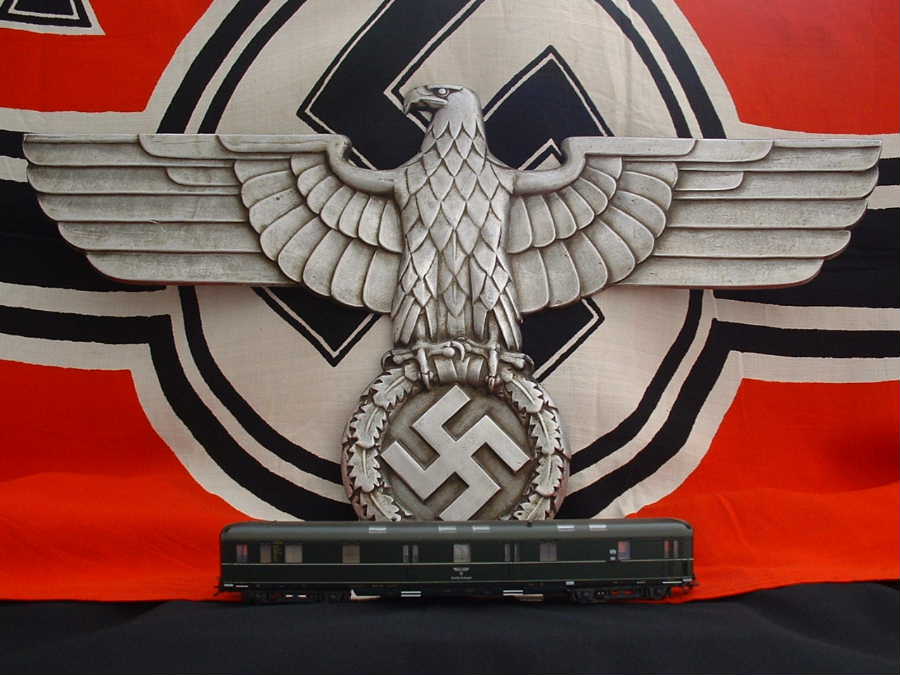
Very much as in the same way that practically all 3rd Reich badges, cloth, uniforms, medals, daggers and etc, have been reproduced post war, we see a variety of copies of the railroad eagle that have hit the collectors market going back several years now. While many of the reproductions have been manufactured and marketed solely as “collector copies” in the past, today we are now seeing a more concerted effort in manufacturing practices of these eagles to actually defraud the collecting community. As the prices of legitimate WWII produced railroad eagles have climbed in today’s market to the value of several hundred dollars, the prices of even the post war reproductions so too have risen considerably. A check of Rex Reddick Enterprises which sells a plethora of every imaginable post war 3rd Reich item listed in their on-line website, shows this firm offering newly made railroad eagles for $90.00 each. A check of Ron Manion’s military auction catalogs of the mid 80’s, show original railroad eagles consistently selling at the $100-$200 price range. It’s quite remarkable that the reproduction that we see being offered today, are selling for what the originals did nearly 30 years ago!

It would be nice to be able to take the measurements of a 3rd Reich railroad eagle and state, that if the one that a collector was examining for originality did not conform to the dimensions of an original example, than it was definitely a post war reproduction. Well, there is a little more to it than that, but you will see that with a little experience in recognizing the feature known to be present on an authentic eagle, it becomes easier to spot a reproduction.

It is commonly accepted by the collecting community that the railroad eagles were manufactured in lengths of 24, 27, 28 and 35 inches. (600, 680, 720, and 900 mm). In light of the fact that one manufacturing firm’s 24” variety eagle may measure a ¼ or ½ inch longer that one produced by another company, we know that the LOK 600 stamped eagles actually measure out to be a 23 ½ inch wing span running from tip to tip. Consequently as collectors, we cannot rely solely on dimension of a railroad eagle as being a true guide to authenticity. No doubt the slight variation in these measurements from one molding company to the next, was due to the hand finishing and de-burring process involved finishing the final product.

The obverse

When inspecting a railroad eagle for authenticity, a collector will normally examine the obverse striking pose of the eagle perched proudly on a ring of oak leaves, superimposed swastika, and outstretched wings. With a period manufactured eagle, we see a nice 3 dimensional bird cast in a relatively smooth natural aluminum finish. The fact that these eagles were the result of being produced from a mold, a collector may observe slight flaws in the metal surface in different areas of the plaque. Minor pock marks and residual metal that may have become trapped in the mold, could exhibit additional imperfections. Occasionally this has caused collectors to become overly concerned that the prized railroad eagle in their collection, is a reproduction. Be rest assured that not all of these eagles were cast with exact precision of flawlessness. If an eagle were to exhibit such gross flaws such as large scale porosity, missing or incomplete feather features, or a gritty rough surface throughout, this would raise a red flag of concern. For the majority of railroad eagles produced during the 3rd Reich, these hand polished eagles will exhibit a smooth obverse, and void of rough edges when you run your hand around all of the surfaces of the plaque. Bear in mind that if a railroad eagle was exposed to weather elements, or submerged in soil or water, this very well could affect metal and the appearance of how it now looks.

Although all 3rd Reich railroad eagles were cast with  integral cone/stud fastening structures that was part of the mold, at times collectors will come across an eagle that has had holes drilled through the plaque. Because the only period photos that the collecting community has showing these railroad eagles displayed during the 3rd Reich are usually small and faint, verification of this method of attaching an eagle plaque cannot be positively confirmed. The drilled holes occasionally found on railroad eagles may certainly be the handy work of a veteran, and done in order to display his war trophy. But eagles found with precise, machined, and countersunk holes, may lend credence to the possibility that perhaps at least some were indeed fastened using a system other than the normal stud method.

Another anomaly that is occasionally observed with these railroad eagles, are examples that display painted swastikas, wreaths, and even the entire eagles themselves. Once again because the lack of clear and concise period photographs of eagles being displayed during the period, it is impossible to determine with certainty whether this type of enhancement occurred during the 3rd Reich period, or sometime later post war. Collectors have found eagles from veteran sources that have old paint to these areas, but just how old this or when it took place, is mostly speculation.

As with most collectibles, the natural undisturbed patina that has accumulated over time on an item, is something that is difficult to replicate on any reproduction. Very often we see eagles that are covered in soot from coal dust and almost completely black. No doubt this is likely sign that the plaque was affixed to a Reichsbahn locomotive or coach car, that moved men and supplies in and out of Germany during WWII. While some eagles offered in the collecting community today have been cleaned or even polished, they were probably never manufactured with a high luster shine. The more rough and sometimes porous surface suggests that these plaques were most likely finished to a degree that left them with a dull natural matte aluminum appearance.

Finally, one of the most important traits to the identification of a 3rd Reich railroad eagle, is to look for the evidence of hand filing or grinding that is usually found around the perimeter edges of these plaques. This was performed to d-bur and smooth the outline of the eagle, after it was removed from the manufacturing mold. The area that is most noticeable of this hand filing, is  the upper wing ridge which runs tip to tip, across the top of the entire wingspan. At times, even the top of the eagle’s head area will show course grinding marks also. This hand filing and grinding can actually can give the metal a squared off shape, as opposed to being round. Look for evidence of hand finishing, it can be an important tool in identification.

Makers Mark

With few exceptions, nearly every 3rd Reich era railroad eagle will exhibit some type of maker marks and or numbers/symbols, that are usually recessed in the reverse side of the plaque. These maker marks are actually part of the mold, and not something that is stamped later, after completion of the final product. Since many of the firms responsible for the manufacturing of these eagles have never been identified, the collecting community usually refers to them by the initials seen on the reverse. In other words; 28″ J&Z, PS LOK 680, HE, etc. By no means does the presence of any maker marks, actually make a railroad eagle legit. Because we know that post war reproduction eagles, will also exhibit these same manufacturing symbols. Most reproductions that are found in the collecting community, have been cast using an actual 3rd Reich eagle, as a pattern. Even with some period railroad eagles, a collector will at times find it difficult to clearly identify the makers initials. Some of these symbols are very obscure, and use a small font. Consequently maker marks alone, are truly not a definitive method for authenticity nor identification.

The ! SS Daggers

The ! SS Daggers

No Slide Found In Slider.

The ! SS Daggers

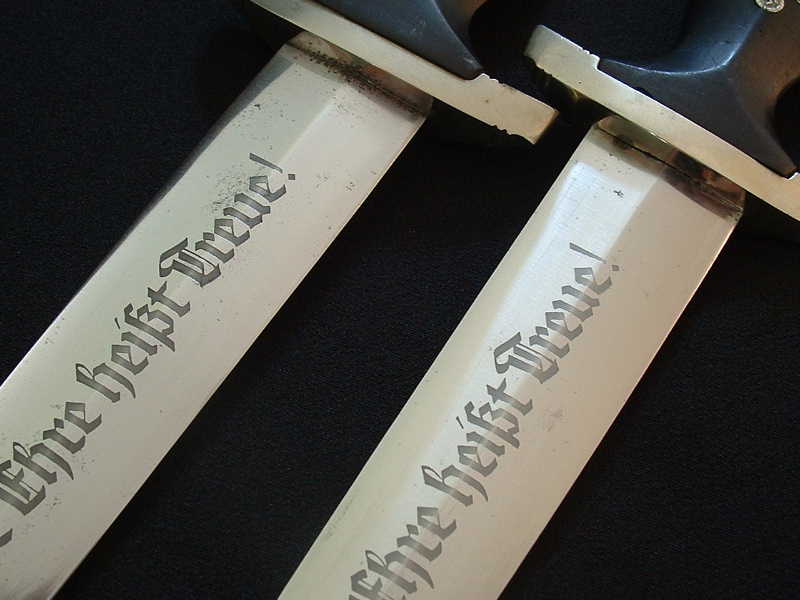
If you’ve ever read through Witty’s bible on the Exclamation Motto SS Daggers, it’s not only confusing as to which company made which dagger during what time period, but we really have never understood why these special SS daggers were even produced in the 1st place. I’ll try to do my best to explain this if I can. With period produced and known M33 SS trademarked daggers in collections today, we know for sure that at least 2 edged weapon firms made the Exclamation Motto etched blades. Those 2 companies were Jacobs and K&M ( Klittermann & Moog). For years the collecting community always assumed that the RZM 7/29 Exclamation Motto SS daggers were the work of the Jacobs company because of the association of the trademarked pieces that are seen produced by this company. To my knowledge, there are only a couple (1-3) of the Klittermann & Moog trademark early 33’s in existence, so the association of the RZM 7/29 was assumed to be the product of the Jacobs firm when the RZM code system took the place on blades. To confuse the matter more, collectors were faced with Exclamation Motto SS daggers that carried the RZM 324/37 & RZM 324/38 maker codes. Once again the collecting community assumed that this  was the Jacobs firm being assigned a new manufacturing code under the confusing RZM system. Bear in mind that we didn’t even know of any maker marked Klittermann & Moog in existence and it is only recently that a couple have come to light.

Through the research of period information on the RZM assigned numbering system, we know that the Jacobs company was issued the license code of M 7/34 up until the year of 1935. So in fact this was just a short period from the end of where we see maker marked blades being produced, and the RZM numbering system being installed. During the years of 1936-1938 the Jacobs RZM number disappeared from the license list of those firms producing SA & SS daggers. In 1939 the RZM code of M7/118 is now seen with the Jacobs firm being assigned this new code. The RZM license list of 1939 shows the same exact address of the Jacobs firm as was listed in the 1935 list. Evidently the company either shut down for 3 years, went under or something because there is no evidence of this firm being listed again as a dagger producer until 1939.

The code of RZM M7/29 with the Klittermann & Moog trademark has been found on Transitional SA daggers bearing both of these proofs on the same blade. So this does tie the RZM M7/29 SS Exclamation Etch to the K&M firm in my mind. There are some characteristics of both the K&M and Jacobs SS daggers that we see in common. Among these are:

1.  Both companies were located in the same building in the city of Solingen, just 1 floor apart from each other.

2.  All the Exclamation Motto SS daggers are always found with the earliest materials, ie. nickel fittings on not only the dagger itself, but also on the scabbards.

3.  All of the blade etches have the same characteristics to the etched letters.

4.  With the exception of only one trademarked K&M example, none have district marks on the reverse of the crossguards.

5.  We do see some different caster marks in the crossguards, but once again even the RZM 324/38 marked blades are found with nickel fittings.  Something that is rarely seen in this later production time.

As I’ve stated before, these had to be some type of Honor Dagger that was produce for a special occasion or special SS group. Himmler didn’t allow personalization’s, alterations, nor deviations of the production of any SS daggers unless it was approved by him personally. Look what happened with the Sepp Dietrich SS Sword. He wore it twice before Himmler put a halt to it. There is no way that 10-12 companies had to do it one way and 2 other little firms got to add a little flare to their blade etch!

Well, hope this kind of sums it up to the best of my information, but there is one other thing that I didn’t touch on and that is, where and how does the RZM 324/37 & 38 SS marked blades fit in ??? Heaven knows the answer to that one as we can’t definitely tie those to either company but most likely they were produce by K&M. If you look at the RZM code and the style of font that the number have, they point toward Klittermann & Moog.